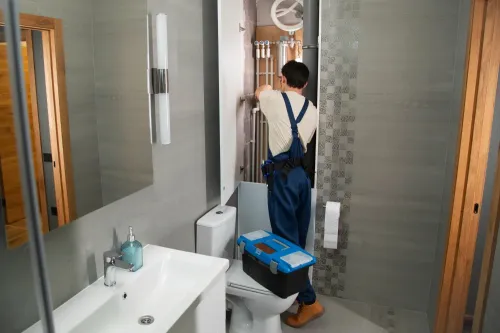
A dependable water arrangement starts with more than a tank and a pump: you need to match the source, storage, treatment, pipework and pressure equipment to the property. By the end, you will be able to compare supply layouts, estimate demand, identify Nashik-specific risks and ask for a system design that can be tested and maintained.
Key takeaways
- Identify every source, inlet, stop valve, filter and storage tank before sizing equipment.
- Choose direct, overhead-tank or combined supply based on pressure, reliability and available space.
- Test source water before selecting treatment, pipe materials or storage arrangements.
- Check pipe routes, pump controls, tank access and leak points before commissioning.
How water moves from the source to every tap
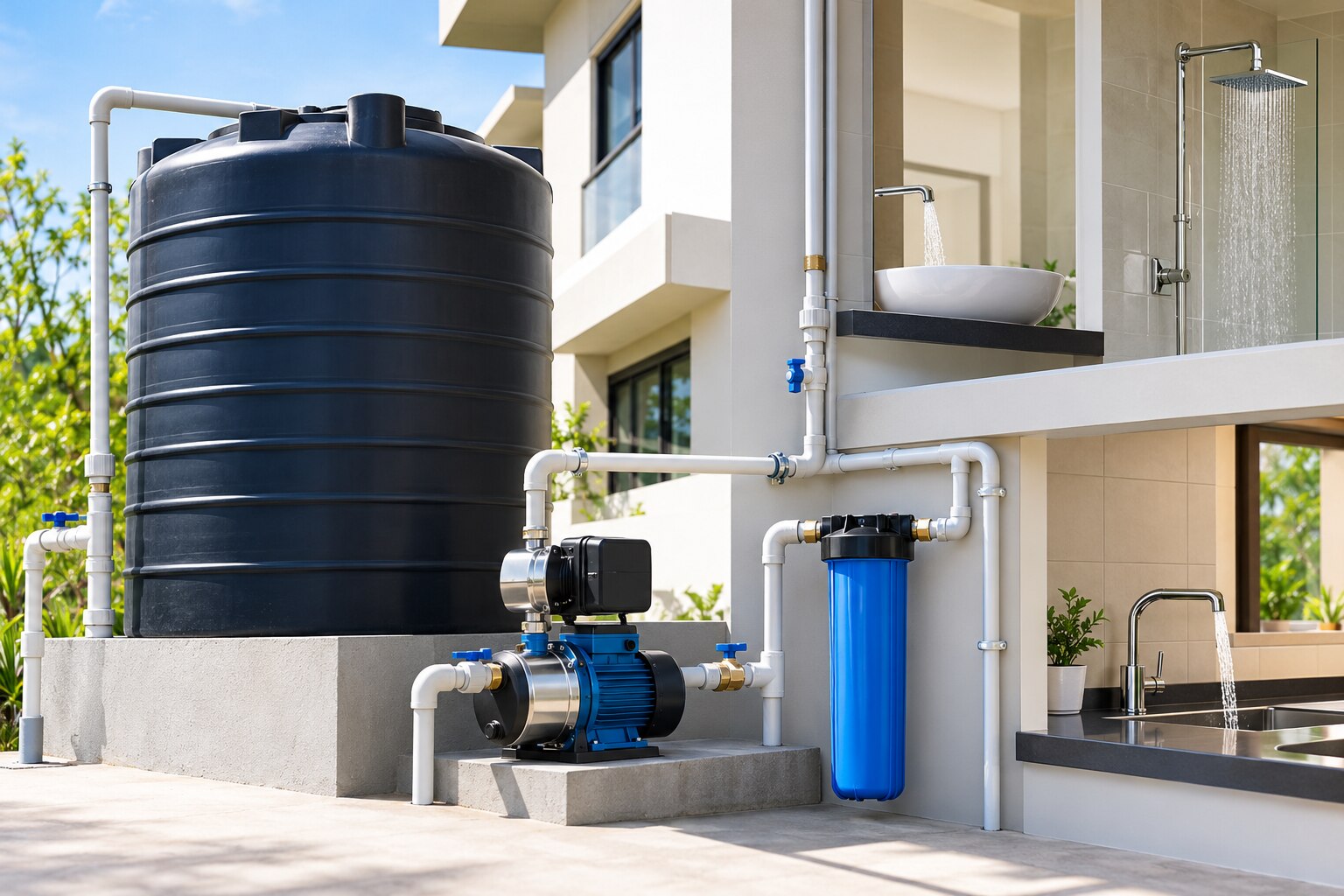
A complete system moves water from a municipal connection, borewell or tanker inlet through a meter, stop valve and filter to storage or directly to the building.
The usual chain is an underground or ground-level tank, transfer pump, overhead tank, pressure pump, distribution manifold, branch pipes, isolation valves and fixtures such as taps, showers and flush tanks.
Building water supply systems should keep drinking-water lines separate from flushing, gardening and HVAC make-up lines. An air gap or suitable backflow preventer protects against back-siphonage; a check valve alone is not enough. Keep hose ends above tank water and never connect a potable pipe directly to a contaminated source.
| Arrangement | How water moves | Main advantage and limitation |
|---|---|---|
| Direct municipal | Mains feed fixtures through a meter and valves | Simple, but fails when supply is intermittent or pressure is low |
| Indirect storage | Mains fill a ground-level tank; a pump fills the overhead tank | Reliable reserve, but needs tank space and electricity |
| Overhead gravity | The overhead tank feeds fixtures by gravity | Works during pump outages, but upper-floor pressure can be weak |
| Hydro-pneumatic | A pump and pressure vessel feed fixtures without an overhead tank | Consistent pressure, but requires controls, maintenance and backup power |
| Hybrid | Storage, overhead gravity and pressure pumping serve different zones | Flexible for multi-storey properties, with higher design complexity |
For water supply systems in Nashik, verify municipal timing and pressure before choosing direct supply. Ten metres of height consumes about 1 bar before pipe friction, so a ground-floor connection that seems strong may not serve upper floors. Treat borewell water separately: test its yield and quality before using it for drinking.
Choosing a supply arrangement for a Nashik property
A one- or two-floor home with reliable municipal timing can use direct supply, but verify pressure at the highest tap before choosing it. Each 10 metres of elevation consumes about 1 bar of static pressure, before pipe friction and fixture demand; a ground-floor test can therefore mislead you.
| Arrangement | Best fit | Main limitation |
|---|---|---|
| Direct municipal | Small, low-rise home; dependable timing and pressure | Upper floors lose pressure during interruptions |
| Ground or underground tank to overhead tank | Multi-storey home, apartments, unreliable municipal supply | Needs tank space, pump power and cleaning |
| Hydro-pneumatic | Buildings needing steady pressure at several floors | Higher cost, controls and maintenance |
| Hybrid | Municipal plus borewell or tanker backup | Requires separate sources, controls and safe storage |
For residential water supply systems in nashik, size storage from occupants, design consumption, interruption duration, available terrace or plant-room area and fire provisions where applicable. An oversized tank is not automatically safer: unused water collects sediment and supports algae or microbial regrowth.
- Choose direct supply only after measuring pressure during both supply and non-supply periods.
- Choose a ground-level or underground break tank with transfer pumping for multiple floors or an intermittent connection.
- Use an overhead tank for dependable gravity backup when power cuts or pump faults are likely.
- Use hydro-pneumatic boosting when upper-floor showers, multiple simultaneous users or commercial fixtures need stable pressure.
- Keep potable, flushing, gardening and HVAC water separate; specify filtration and source controls within the water system solutions in nashik design.
Testing water and calculating storage and pump capacity
Size storage from people and interruption, not from plot area. Calculate occupants × the design consumption rate adopted by the local authority or project engineer × the number of days the source may be unavailable, then add separately calculated fire storage where required. Review the result against tank space and cleaning access.
For residential water supply systems in Nashik, verify the municipal schedule and pressure at the property instead of assuming continuous service. Record borewell yield and tanker delivery separately; do not combine unlike sources in one estimate.
Test every source at the point where it enters the property. Send representative samples to a laboratory and request:
- pH, turbidity, total dissolved solids and hardness
- Chloride, sulphate, nitrate, iron and fluoride
- Total coliform and E. coli microbiological tests
Run a borewell yield test by pumping at the proposed rate, measuring drawdown and recovery, and repeating the check in the dry season. Water quality does not prove dependable yield, and drilling does not replace source approval or metering.
Size the transfer pump for the required refill flow and total dynamic head: static lift, pipe friction, fittings and the pressure needed at the inlet. Ten metres of elevation consumes about 1 bar before friction and fixture pressure; a pump that fills a tank quickly can still leave upper floors weak.
For building water supply systems, split potable, flushing, gardening and HVAC make-up demand before sizing pumps and tanks. Keep storage moderate: an oversized, stagnant tank invites sediment, algae and microbial regrowth. Use an air gap or suitable backflow preventer where contaminated sources could siphon into potable lines.
Selecting pipes, protecting water quality and preventing leaks
Specify the pipe by service, not by a generic label such as PVC. Potable cold water, hot water, buried services, exposed outdoor runs and chemically treated water need different pressure ratings, jointing methods and protection.
| Option | Suitable location | Specify and protect |
|---|---|---|
| CPVC or approved hot-water system | Internal hot-water branches | State the applicable Indian Standard, temperature and pressure rating; use compatible fittings |
| uPVC or HDPE pressure pipe | Cold-water distribution or buried service | Match the pressure class, jointing method and pump pressure; protect exposed pipe from UV |
| Stainless steel or approved metal pipe | Plant rooms, risers or exposed mechanical areas | Use corrosion-compatible fittings and provide isolation valves for maintenance |
| Any approved potable-water pipe | Tank outlets and drinking-water branches | Confirm potable certification and keep it separate from non-potable lines |
Building water supply systems must separate drinking water from flushing, gardening and HVAC make-up water. Prevent back-siphonage with an air gap or suitable backflow preventer; never leave a hose submerged in a tank, drain or chemical container. A check valve alone is not enough.
For water supply systems in Nashik, identify every source separately because municipal, borewell and tanker water can differ in hardness, fluoride, nitrate, iron and bacteria. Test each source before selecting filters or RO.
Prevent concealed failures with pressure testing before plastering, accessible isolation valves, sleeved wall penetrations, labelled branches and leak detection around tanks and pumps. Clean and inspect storage tanks on a defined schedule.
Checking the design before installation and commissioning
Approve the drawing only after it proves that each tap will receive safe water at the required flow and pressure during the property’s worst supply conditions. For water supply systems in Nashik, do not treat a municipal connection as continuous until its schedule and pressure have been measured on site.
1. Trace every source separately: municipal line, borewell or tanker. Record the meter, stop valve, filter, storage tanks, pumps, non-return devices and isolation valves. Confirm that the proposed break tank or underground tank can receive water during the verified supply window.
2. Check storage against actual occupants, design consumption, interruption duration, terrace or plant-room space and fire requirements where applicable. An oversized tank encourages sediment, algae and microbial regrowth.
3. Calculate pressure at the highest fixture, not at the entrance. Every 10 metres of elevation uses about 1 bar before friction and fixture losses; add pump capacity only after these losses are calculated.
4. Review laboratory results for pH, turbidity, total dissolved solids, hardness, chloride, sulphate, nitrate, iron, fluoride and microbiological parameters. Use them to select filtration, softening or RO treatment.
5. Confirm separate potable and non-potable lines, air gaps or suitable backflow prevention, tank access, overflow discharge, drain points and leak-test points. Specify the Indian Standard, pressure class, jointing method and UV protection for each pipe service.
6. Commission in stages: flush pipes, disinfect tanks and lines, test pressure, verify pump controls, measure upper-floor flow and inspect every joint.
Professional design support is valuable for multi-storey buildings, mixed water sources, hydro-pneumatic systems or tight tank space. Mukta Group can help coordinate product selection with an engineered installation rather than leaving compatibility to the installer.
Related products
 | Mukta Plumbing Store Step into our multi-storey showroom and explore a curated range of premium and luxury plumbing solutions designed to elevate modern living, showcased... View product → |
 | Mukta Plumbing Engineers And Contractors Mukta Plumbing Engineers And Contractors With a strong foundation in plumbing engineering, MPEC has built a reputation for executing high-quality, durable systems tailored to each project’s... View product → |
Frequently asked questions
How does water reach every tap in a Nashik property?
Water enters from a municipal connection, borewell or tanker inlet, then passes through metering, isolation, filtration and storage or direct distribution before reaching fixtures.
Which water supply arrangement suits a home or building?
Compare direct supply, overhead-tank supply and combined systems against source reliability, incoming pressure, power availability, building height and storage space.
What must you test before sizing tanks and pumps?
Test source quality and measure demand, available pressure, building height, pipe-run length and required storage before selecting pump capacity and controls.
How can you prevent leaks and protect water quality?
Select suitable pipe materials and joints, separate potable and non-potable lines, provide isolation valves, protect tanks from contamination and inspect accessible leak points.
Related product
 | Mukta MEP Mukta MEP is a leading name in the field of Mechanical, Electrical, and Plumbing (MEP) services, known for delivering high-quality, reliable, and... View product → |
Keywords